What Is HRA and Why Do You Need a Rent Receipt?
House Rent Allowance (HRA) is a component of salary that employers may provide to employees to help cover rental accommodation expenses. Under Section 10(13A) of the Income-tax Act, 1961, eligible salaried employees can claim an HRA exemption when they meet the prescribed conditions.
A rent receipt for income tax purposes is documentary proof that you have paid rent to your landlord. Employers commonly ask employees to submit rent receipts while processing investment and tax declarations.
One important point for FY 2025-26: HRA exemption is available under the old tax regime, but not under the new tax regime. Therefore, check your selected tax regime before collecting documents or calculating your potential exemption.
HRA Exemption Rules for FY 2025-26
Under the old tax regime, the exempt HRA amount is generally the lowest of these three calculations:
- Actual HRA received from your employer.
- Rent paid minus 10% of your salary.
- 50% of salary if you live in Delhi, Mumbai, Kolkata or Chennai, or 40% for other locations.
For this calculation, salary generally means basic salary plus eligible dearness allowance and qualifying commission, as prescribed under the rules.
Here are some important points tenants should remember:
- Keep monthly rent proof: Maintain receipts for the months for which you are claiming HRA. Your employer may ask for monthly receipts or a consolidated statement, depending on its documentation policy.
- Landlord PAN requirement: If your annual rent exceeds ₹1,00,000, you must report your landlord's PAN to your employer.
- Revenue stamp: Under the general central stamp-duty schedule, a receipt acknowledging an amount exceeding ₹5,000 attracts receipt stamp duty. State amendments and applicable rules can differ, so check the requirements where the property is located.
- Payment records: Pay rent through UPI, NEFT, IMPS or bank transfer wherever possible. These transactions provide useful supporting evidence.
- Genuine rental arrangement: You must actually pay rent for the accommodation. A receipt alone does not establish eligibility if the underlying rental arrangement is not genuine.
If your landlord does not have a PAN, ask your employer which declaration or alternative documentation it accepts. Do not assume that the claim will automatically be rejected or reduced without checking the applicable requirements.
Standard HRA Rent Receipt Format
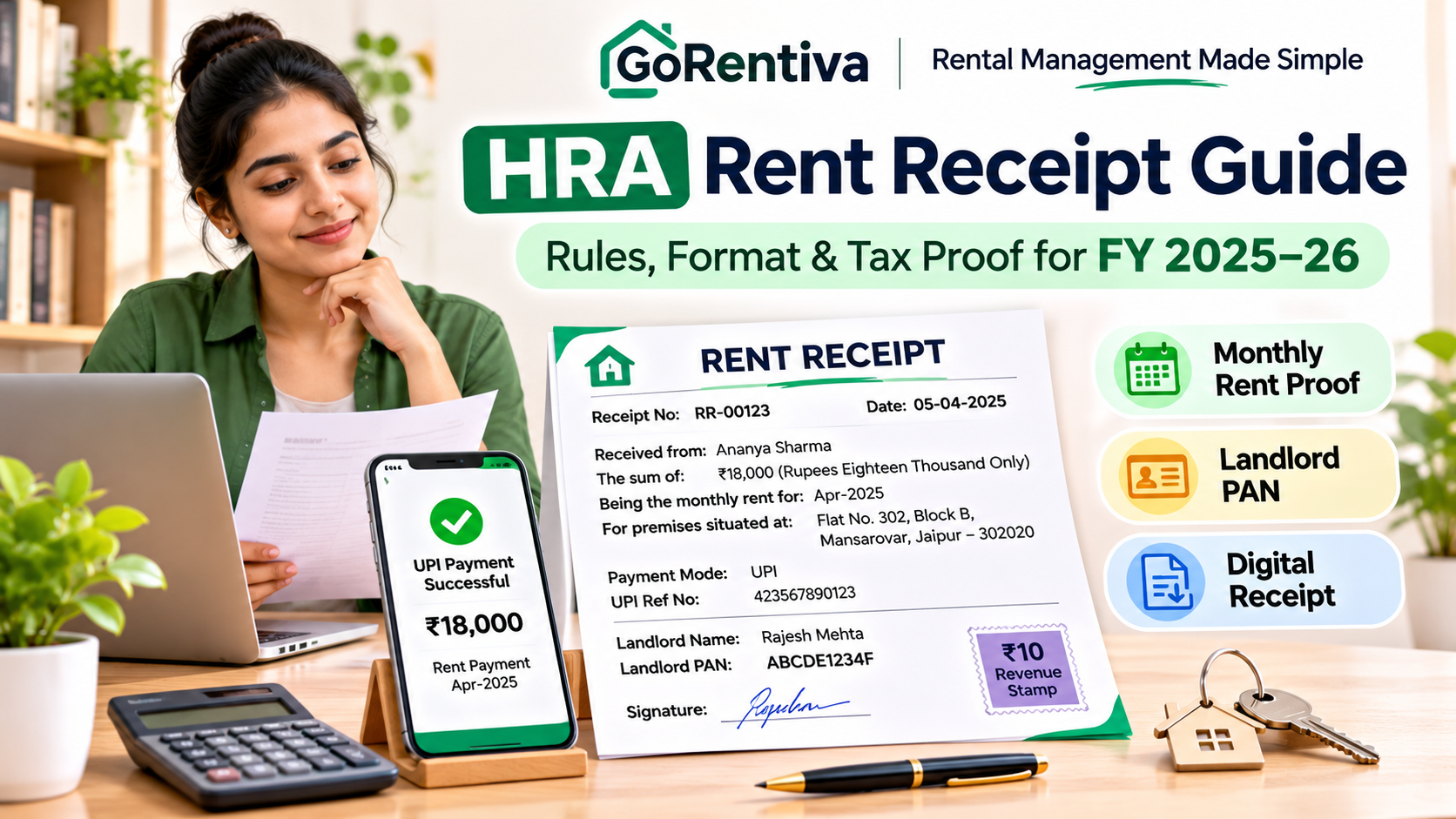
A rent receipt should clearly identify the tenant, landlord, rented property, rental period and amount paid. It should also include payment details wherever available.
You can use this sample monthly rent receipt format:
RENT RECEIPT
Receipt No.: [Receipt Number]
Date: [DD-MM-YYYY]
Received from: [Tenant's Full Name]
Amount received: ₹[Rent Amount]
Amount in words: [Amount in Words]
Being the monthly rent for: [Month and Year]
Property Address: [Complete Rental Property Address]
Payment Mode: [UPI / Bank Transfer / Cash / Cheque]
Transaction Reference: [UPI ID / UTR / Cheque Number]
Landlord Details
Landlord Name: [Full Name]
Landlord PAN: [PAN, where applicable]
Landlord Signature: __________________
Revenue Stamp: [Where applicable]
A properly completed receipt should match the actual rent paid and the rental period. Avoid entering incorrect dates, amounts or transaction references.
Common Rent Receipt Mistakes to Avoid
Even when tenants pay rent regularly, mistakes in documentation can create problems during employer verification.
1. Creating backdated receipts: Do not create false or misleading receipts for previous months. Maintain records as rent is paid and request missing receipts from your landlord.
2. Missing landlord signature: A receipt should be authenticated by the landlord. If you use a digital receipt, check whether your employer accepts its electronic signature format.
3. Incorrect landlord PAN: Verify the PAN carefully, particularly when annual rent exceeds ₹1 lakh.
4. Mismatched payment records: The rent amount and payment date should reasonably match your bank or UPI records.
5. Incomplete property address: Include the full address of the rented premises so that the accommodation can be identified.
Are Digital Rent Receipts Accepted for HRA?
Digital rent receipts can be useful proof of rental payments. A properly prepared PDF containing the landlord's details, tenant's name, rental period, amount, property address and landlord authentication can help maintain a clear record.
However, do not assume that every emailed receipt, scanned signature or image of a revenue stamp is automatically accepted by every employer. The Income-tax Department's HRA provisions do not create a blanket guarantee that a particular PDF format will satisfy every employer's documentation policy.
Before submitting digital receipts, check your company's HR or payroll requirements. Keep your UPI transaction history, bank statement, rental agreement and other supporting documents safely.
How GoRentiva Can Simplify Rent Receipts
Managing rent receipts manually can become difficult when landlords handle multiple tenants or properties. GoRentiva aims to make rental record-keeping simpler by bringing rent payments and receipts together.
Where the relevant payment and receipt features are enabled, landlords can use GoRentiva to:
- Maintain tenant and rental payment records.
- Generate PDF rent receipts for recorded payments.
- Include relevant landlord and tenant information.
- Keep payment references available for record-keeping.
- Access past rental payment records without searching through old messages.
Tenants and landlords should always verify that the receipt reflects the actual payment received. Features such as automatic payment-reference capture, PAN pre-filling and digital signatures should be used only where enabled and supported by the payment workflow.
Manage your rental records more conveniently with GoRentiva. Visit GoRentiva to explore its property and rent management features.
Final Checklist Before Submitting Your HRA Claim
Before submitting your HRA documents for FY 2025-26, make sure you have:
- Checked that you are using the old tax regime if claiming HRA exemption.
- Collected rent receipts for the relevant rental months.
- Verified the landlord's PAN if annual rent exceeds ₹1,00,000.
- Checked applicable revenue-stamp requirements.
- Matched receipts with actual rent payments.
- Confirmed your employer's accepted document format.
- Kept your rental agreement and payment records safely.
Good documentation makes HRA verification easier and helps you maintain reliable rental records throughout the financial year.
Comments
Be the first to share your thoughts.
Leave a comment